What Is a GVM Upgrade? WA Rules & Benefits Explained
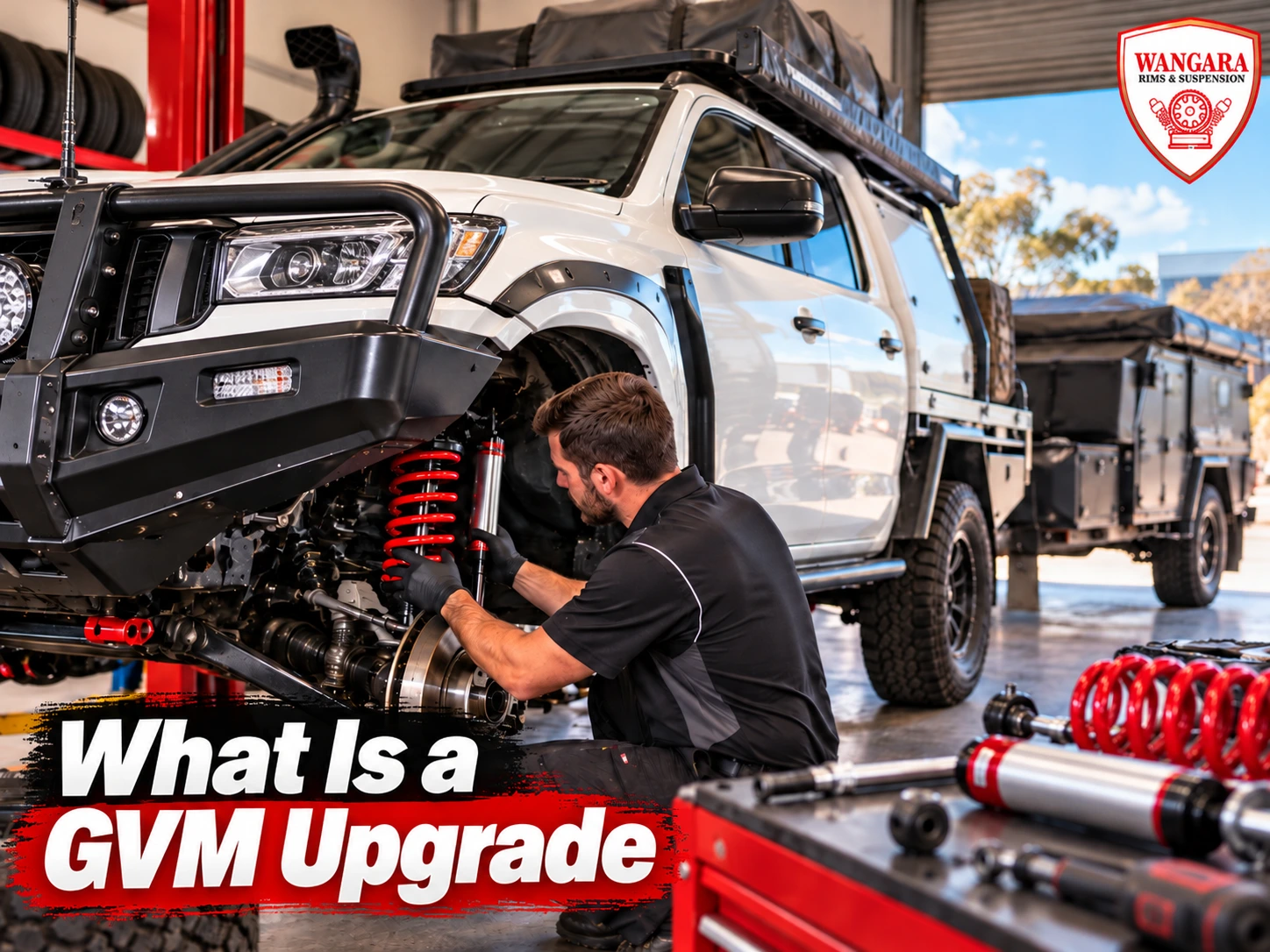
A GVM upgrade is a certified set of changes that raises the maximum loaded weight your 4WD is rated to carry. In Western Australia, it is a formal modification with its own approval process, not something you can simply bolt on. Other states and territories set their own rules, so this guide applies to WA. Whether you need one comes down to what your vehicle weighs when it is packed for a trip, compared with its GVM rating.
This guide covers what a GVM upgrade involves, what WA requires, how it differs from a lift kit, and how to tell if you are overloaded. It was checked against WA Department of Transport and Major Infrastructure (DTMI) and Commonwealth sources in October 2026. Rules can change, so confirm the current requirements with DTMI before you commit.
What Is a GVM Upgrade?
GVM stands for Gross Vehicle Mass. It is the maximum laden mass of a vehicle as specified by the manufacturer: the vehicle itself, fuel, passengers, accessories, and everything you have loaded into it. DTMI’s Safe Towing Guide Safe Towing Guide says the weight a trailer puts down on the tow ball must be counted as part of the tow vehicle’s GVM.
A GVM upgrade, sometimes called a GVM re-rate, changes certain components so the vehicle can legally carry more than the manufacturer rated it for. GVM and GCM FAQs DTMI says the parts usually upgraded include shock absorbers, springs, control arms, sway bars and struts. The assessment behind it goes wider, covering the chassis, drivetrain, axles, brakes, steering, rims and tyres.
Three terms get mixed up, and the difference matters:
- GVM: the most the vehicle can weigh when loaded.
- GCM (Gross Combination Mass): the most the vehicle and its trailer can weigh together.
- Braked towing capacity: the heaviest braked trailer the manufacturer says it can tow.
A GVM upgrade changes only the first. DTMI is clear that it does not automatically raise GCM, and in WA nobody except the vehicle manufacturer can re-rate braked towing capacity.
Not every vehicle qualifies. WA’s standard for GVM re-rating, VTB-180A, applies to light vehicles with a GVM of 4,500 kg or less, and only to those built on a ladder-type chassis. Vehicles with a combined body and frame (unitary or monocoque construction) are not eligible under it.
How Does a GVM Upgrade Work?
In short, an approved kit goes on, the vehicle is inspected, and the new rating is recorded on a plate and in paperwork. A brand-new vehicle that has never been licensed takes a different path, through a Commonwealth-approved second-stage manufacturer.
The steps below describe the approved-kit route for a vehicle already registered in WA. DTMI also allows a workshop to modify the suspension, with the work certified by an automotive consultant and approved by the department.
Step 1: Check the Vehicle Is Eligible
It needs a ladder chassis and a GVM of 4,500 kg or less. VTB-180A also needs an approved route for your make and model.
There are four: matching a design DTMI has already approved, matching a Commonwealth second-stage manufacturer approval, adding an axle, or matching the manufacturer’s own rating for another variant of the same vehicle. For most 4WD owners, that means a kit already approved for their model.
Step 2: Confirm the Vehicle Is in Sound Condition
The bulletin singles out the shocks, suspension, frame, tow equipment, and brakes, and looks for cracks, leaks, deformation, and rust, including damage from earlier overloading. A tired vehicle is not a candidate until it is repaired.
Step 3: Fit the Approved Kit
On the approved-kit route, only an installer approved for that kit can do the work. The parts matter: swapping in components that are not part of the approved kit, such as softer springs to improve the ride, cancels the approval and the manufacturer’s original rating applies again.
Step 4: Check the Brakes, Tyres and Rims Against the New Rating
The brakes are assessed for the higher weight. The load capacity of the tyres and of the rims must add up to at least the new GVM, and the tyres and rims on each axle must also carry that axle’s potential maximum load. The tyre placard is updated if the tyres change.
Step 5: Present the Vehicle for Inspection
The installer completes and signs an installation checklist. DTMI issues a modification permit once the vehicle passes, and inspection and permit fees apply.
Step 6: Update the Labels and Paperwork
The new GVM goes on the modification plate. A load capacity label is fitted near the tyre placard, and the owner is given updated load and tyre information.
What are The GVM Upgrade Requirements in WA?
DTMI published its current standards for GVM and GCM re-rating in May 2024. The detail sits in VTB-180A, so treat this section as a plain-English summary and not a checklist to work from.
Eligibility, the approved kit and installer, the inspection and permit, and the plates and labels are covered in the steps above. These are the other requirements worth knowing about.
1. All Affected Systems Are Assessed Together
That means the chassis, drivetrain, axles, suspension, brakes, steering, rims and tyres. VTB-180A cannot be used to certify one part on its own, such as springs alone.
2. Stability Control Must Keep Working
If the vehicle has electronic stability control, it must not be disabled or made less effective. Where the overall height increase is above 50 mm, DTMI also wants evidence that it still works properly.
3. Ride Height Is Handled Separately
If a height change needs certification under the national modification code (VSB 14), the GVM process does not replace that. Under VTB-180A, total vehicle lift above 50 mm requires a lane-change test, and suspension height increases above 75 mm will not be approved.
4. Vehicles Re-Rated in Another State
If your vehicle was re-rated in another state, WA does not simply accept it. To be licensed here with the higher rating, the work has to meet VTB-180A.
Otherwise, the manufacturer’s original rating applies. DTMI says a vehicle passing through WA on a trip is treated differently: ratings certified in its home state are recognised while it travels.
GVM Upgrade vs Lift Kit
The two get lumped together because plenty of kits do a bit of both, but they answer different questions. A GVM upgrade is about how much weight the vehicle is rated to carry. A lift kit is about ride height and clearance.
| GVM upgrade | Lift kit | |
| What it changes | The rated load limit, through certified components | Ride height, ground clearance and tyre room |
| Changes your legal load limit? | Yes, once approved, inspected and permitted | No. Heavier-duty springs alone do not change the rating |
| WA approval route | Approved kit and installer, inspection, modification permit, plate | A springs-only raise within 50 mm is a simple modification that needs an inspection and permit. The 50 mm limit is a combined total (see below), and more than that needs certification |
| Effect on ride | Usually firmer, especially when lightly loaded | Depends on the kit |
You can have either without the other. A lift kit can sit on a vehicle that never goes over its GVM, and a GVM upgrade can be done without adding height. When a build does both, it has to meet both sets of rules, and going taller does not make approval easier.
VTB-180A adds a lane-change test above 50 mm of total lift and will not approve suspension height increases over 75 mm. The 50 mm figure is a combined total: under VSB 14 Section LS, suspension lift, body lift and tyre size changes all count toward it.
If height is what you are after, start with our guide to legal lift kit limits in WA. Those rules are separate from the load-rating process described above.
GVM Upgrade Benefits and Trade-Offs
1. What You Gain
- A legal, higher load limit. You can carry more, up to the new rating, with the figure recorded on the modification plate and permit. That is the whole point of it.
- Parts chosen for the load. The shocks, springs and related components are changed and assessed for the heavier weight, so the vehicle is not just relabelled.
- Brakes and tyres checked at the new rating. The process asks whether they can cope with the extra mass instead of leaving it to chance.
2. A Firmer Ride
DTMI says a vehicle with a GVM upgrade kit will usually ride harder and stiffer than a standard one, especially when lightly loaded.
3. No Extra Towing Capacity
GCM stays where it is unless it is separately approved. Raising GVM without raising GCM reduces the trailer weight you can tow once the vehicle is loaded to its new maximum.
4. Warranty and Insurance Questions
Any modification can affect either. DTMI advises checking with the manufacturer and your insurer first, and how your own policy responds is a question only the insurer can answer.
5. Wear, Cost and Time
Running beyond the manufacturer’s original limits can increase wear and tear. Kit, fitting, inspection and permit fees all apply, so ask for a written quote that lists each one.
Do You Need a GVM Upgrade?
A GVM upgrade may be worth considering if the weight you intend to carry is more than your 4WD’s GVM and you cannot reasonably carry less. Working that out takes four steps.
Step 1: Find Your GVM
Check the “Trailer Towing” section of the owner’s handbook, or the compliance plate on vehicles that have one. The manufacturer can also confirm it. If the vehicle has already been re-rated, the modification plate shows the new figure.
Step 2: Work Out Your Payload
Subtract the kerb mass (the vehicle empty, with fuel and standard equipment) from the GVM. As an example with made-up numbers, a ute with a GVM of 3,000 kg and a kerb mass of 2,100 kg has a payload of 900 kg.
Step 3: Add Up What You Actually Carry
Count passengers, water, gear, and every accessory that stays on: bull bar, winch, canopy, drawers, roof rack. Then add the tow ball weight, because DTMI’s Safe Towing Guide says it must be counted as part of the vehicle’s GVM.
The same guide treats 8 to 10 per cent of the trailer’s ATM (aggregate trailer mass) as a guide figure, up to the tow bar’s limit. For a caravan with a 2,500 kg ATM, that gives 200 to 250 kg. Treat that as an illustration only: some designs need a lower figure, so measure the actual tow ball load with the caravan packed for travel, and check the vehicle and tow bar limits.
Step 4: Weigh It
The only reliable check is weighing the vehicle packed the way you really travel, then comparing the result with your GVM. DTMI’s guide says a public weighbridge can do this. Ask for separate axle weights if you can, because a vehicle can sit under its GVM and still overload the rear axle.
What the Answer Means
- Under your GVM with room to spare: you do not need a GVM upgrade. Check axle weights too, and if the vehicle still feels tired, have it inspected.
- Over your GVM: cut the load first. If you cannot, a GVM upgrade may be the legitimate way to carry it, provided your vehicle is eligible.
- Your real issue is towing: check your GCM and braked towing capacity first, because a GVM upgrade will not lift either.
- Your vehicle has a monocoque body: VTB-180A does not cover it.
If you land on “my suspension needs sorting, but I am not overweight”, that is an ordinary suspension upgrade, and our 4WD suspension and lift kits page shows what we supply and fit.
Signs Your 4WD Is Overloaded
Scales settle it, but a loaded 4WD can tell you first. These are the common signs it is working beyond what it was built for:
- The rear sits noticeably low when packed, and the nose looks high.
- The suspension hits the bump stops over ordinary bumps, not just rough ones.
- Handling feels floaty, with more body roll and more steering corrections on the highway.
- The headlights aim up at oncoming traffic.
- Braking takes longer, or the brakes feel overworked on long descents.
- The vehicle feels unsettled or starts to sway when towing.
These can have other causes, such as worn shocks or springs, so do not assume overloading from symptoms alone. For a longer rundown of wear-related problems, see the signs you need a suspension upgrade.
Weigh the vehicle, check axle weights, and have any handling, braking or suspension problem inspected before deciding what to change.
GVM Upgrades and Off-Road Use
A heavily loaded 4WD shows its weight off the bitumen first. Corrugations, sand and rough tracks push the suspension through more of its travel, so a vehicle that feels fine on the highway can start bottoming out once the surface gets rough.
A GVM upgrade does not make a vehicle more capable off-road on its own. It changes how much weight the vehicle is rated to carry, and the components are chosen for that job. The suspension still has to suit where you drive: how much wheel travel it has, how well the shocks control the springs, and how the axle layout copes with uneven ground. Our guide to off-road suspension systems compares those options.
Two practical points if you are combining heavy loads with off-road driving:
Ride Height Affects More Than Clearance
VTB-180A tells assessors to consider changes to suspension travel, brake hose length, handling and roll stability. A wheel alignment check after suspension work is sensible, because a change in ride height alters the alignment angles.
Ask How the Kit Rides Empty
A GVM kit can feel firm when the vehicle is lightly loaded, and you will notice that more on rough tracks. Ask the installer what to expect when the vehicle is empty, not just when it is full.
FAQs
Is a GVM Upgrade Legal in WA?
Yes, when it follows DTMI’s VTB-180A process: an eligible vehicle, an approved kit and installer (or work certified by an automotive consultant), an inspection and a modification permit. A re-rate that does not meet the standard is not recognised in WA, and the manufacturer’s original rating applies.
Does a GVM Upgrade Increase Towing Capacity?
No. It does not change GCM or braked towing capacity. In WA, only the vehicle manufacturer can re-rate braked towing capacity, and a higher GVM without a higher GCM reduces the trailer weight you can tow when fully loaded.
Can Any 4WD Have a GVM Upgrade?
No. VTB-180A covers light vehicles up to 4,500 kg GVM built on a ladder-type chassis, and your make and model needs an approved route. Vehicles with a combined body and frame are not eligible.
Will a GVM Upgrade Affect My Insurance or Warranty?
It can. DTMI says any modification has the potential to affect both, and advises checking with the manufacturer and your insurer before going ahead.
Does a GVM Upgrade Make the Ride Harder?
Usually, yes. DTMI says vehicles fitted with a GVM upgrade kit typically ride harder and stiffer than standard ones, particularly when lightly loaded.