What Is the Legal Limit for a Lift Kit in WA?
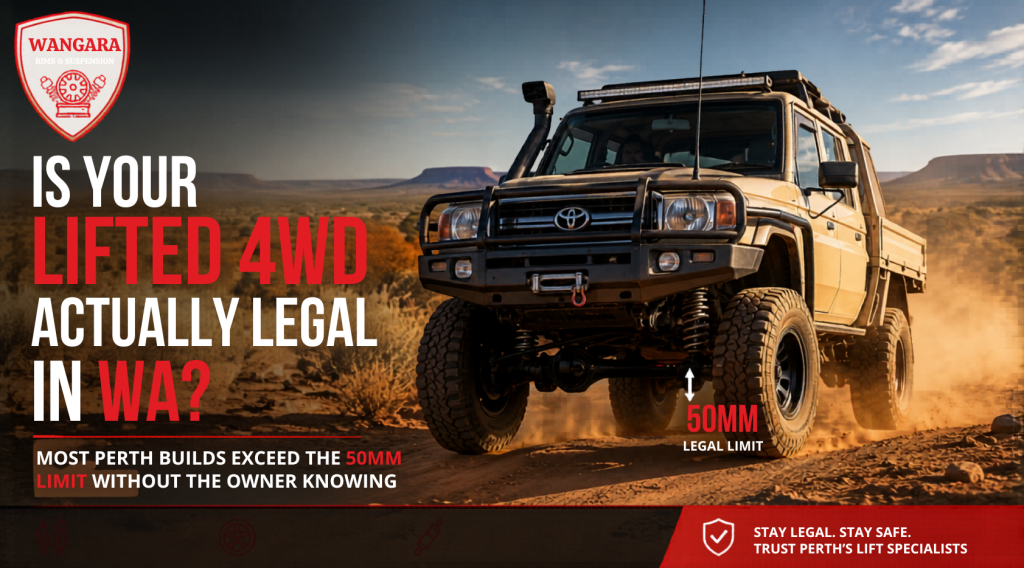
Most Perth 4WD owners think they know the answer: 50mm and you’re fine. The problem is that knowing the number and calculating it correctly are two different things. Most builds that end up with a defect notice, a rejected insurance claim, or a failed roadworthy inspection were built by people who thought they were within the limit.
The legal limit for a lift kit in WA is 50mm combined. That means your suspension lift, tyre diameter increase, and any body lift all count together toward that one number. Not 50mm each. 50mm total.
This rule is set under VSB14, the national code of practice for light vehicle modifications, and is enforced in WA by the Department of Transport and Major Infrastructure. Exceed 50mm combined without engineering certification and your vehicle is non-compliant under WA law, regardless of how it rides or how it looks.
A 2-inch lift plus bigger tyres is the most common setup we see in Perth. It regularly pushes past 50mm once the actual numbers are run. By the time most people find out, the work is already done and the vehicle is already on the road.
This guide shows you exactly how to calculate your total lift, which tyre and suspension combinations stay legal, and what’s actually at stake if you get it wrong.
Why Perth 4WD Owners Lift Their Vehicles
Western Australia has some of the most demanding driving conditions in the country. Long distances through regional areas, beach tracks, corrugated station roads, and remote outback routes put a standard factory ride height at a real disadvantage.
Lifting a vehicle gives you more ground clearance over rocks and ruts, better approach and departure angles on steep terrain, more wheel travel for off-road traction, and room to fit larger tyres for better grip on sand and gravel.
That’s why 4WD lift kits are one of the most popular modifications in Perth. But the same upgrade that makes your Hilux or Ranger capable off-road can create serious legal and financial problems if the combined height pushes past WA’s limit. Most builds do.
How the 50mm Combined Limit Actually Works
The 50mm rule is not about suspension alone. It covers the total height increase from every modification combined.
| Modification | What It Adds to Your Total |
|---|---|
| Suspension lift | Height gained from new springs, shocks, or spacers |
| Tyre diameter increase | Extra height from fitting larger tyres than factory spec |
| Body lift | Height gained by raising the body off the chassis |
All three stack together. If the combined total exceeds 50mm, you need an engineering certificate before the vehicle is legally roadworthy in WA.
Most people only think about the suspension number. Tyres are where the calculation quietly crosses the line. That’s exactly what we see happening with builds that come through our workshop in Wangara.
How to Calculate Your Total Lift Height
This is the step most guides skip entirely. Without this calculation, you are guessing. And guessing is how people end up with a defect notice on a build they thought was legal.
Step 1: Find your stock tyre size
Open your driver’s door and look at the placard on the door jamb. It shows your factory tyre size, for example 265/65R17. This is your reference point for everything below.
Step 2: Calculate your stock tyre’s overall diameter (OD)
The tyre size breaks down like this: 265 is tyre width in mm, 65 is the aspect ratio (sidewall height as a percentage of width), R17 is the rim diameter in inches.
Formula: Sidewall height = Tyre width x Aspect ratio / 100 Tyre OD = (Sidewall height x 2) + (Rim diameter x 25.4)
Worked example using 265/65R17 (stock Hilux): Sidewall = 265 x 0.65 = 172.25mm Rim = 17 x 25.4 = 431.8mm OD = (172.25 x 2) + 431.8 = 776.3mm
Step 3: Calculate your new tyre’s OD
Do the same for the tyre you’re planning to fit.
Worked example using 285/70R17 (common Hilux upgrade): Sidewall = 285 x 0.70 = 199.5mm Rim = 17 x 25.4 = 431.8mm OD = (199.5 x 2) + 431.8 = 830.8mm
Step 4: Calculate the height increase from the tyre
The tyre grows both upward and downward from the wheel centre, so you divide the diameter difference by 2.
Height increase = (New tyre OD – Stock tyre OD) / 2 (830.8 – 776.3) / 2 = 27.25mm
Fitting 285/70R17 tyres on a stock Hilux adds approximately 27mm to your vehicle height before any suspension lift is added.
Step 5: Add everything together
Combined total = Suspension lift + Tyre height increase + Body lift
| Modification | Height Added |
|---|---|
| 50mm suspension lift | 50mm |
| 285/70R17 tyres on stock Hilux | ~27mm |
| No body lift | 0mm |
| Combined total | ~77mm |
That’s 77mm combined. Non-compliant in WA. Engineering certificate required.
This is one of the most common setups we quote for in Perth. Most customers are genuinely surprised when the numbers come out over the limit. Planning this before parts are ordered saves a lot of problems later.
Real Builds: Legal vs Non-Compliant in WA
These are based on common Perth setups calculated using the method above.
| Vehicle | Suspension Lift | New Tyre vs Stock | Tyre Height Increase | Combined Total | WA Legal? |
|---|---|---|---|---|---|
| Hilux (stock 265/65R17) | 25mm | Stock tyres | 0mm | 25mm | Yes |
| Hilux (stock 265/65R17) | 40mm | 265/75R16 | ~16mm | ~56mm | Needs certificate |
| Hilux (stock 265/65R17) | 50mm | 285/70R17 | ~27mm | ~77mm | Needs certificate |
| Ranger (stock 265/65R17) | 25mm | 275/70R17 | ~16mm | ~41mm | Yes |
| Ranger (stock 265/65R17) | 50mm | Stock tyres | 0mm | 50mm | Yes |
| Prado 150 (stock 265/65R17) | 40mm | 285/65R17 | ~14mm | ~54mm | Needs certificate |
| Patrol Y62 (stock 285/60R18) | 50mm | Stock tyres | 0mm | 50mm | Yes |
| Patrol Y62 (stock 285/60R18) | 30mm | 305/65R18 | ~22mm | ~52mm | Needs certificate |
Is a 2-Inch Lift Legal in WA?
A 2-inch (50mm) suspension lift on its own sits exactly at the legal limit. The problem is that almost nobody runs a 2-inch lift on stock tyres. The whole point of lifting a vehicle is to fit bigger tyres. The moment you do, the combined total goes over 50mm for the majority of builds.
Toyota Hilux with a 50mm lift and 285/70R17 tyres (up from stock 265/65R17): Suspension lift: 50mm Tyre height increase: ~27mm Combined total: ~77mm Status: Non-compliant. Engineering certificate required.
A 2-inch lift is only legal in WA if your tyre size stays at or very close to factory spec. Most real-world builds in Perth exceed 50mm combined. A lot of owners simply don’t know until something goes wrong.
Can I Combine a Lift Kit and Bigger Tyres Legally in WA?
Yes, but only if the combined total stays at or under 50mm.
Your suspension lift and tyre upgrade share the same 50mm budget. You cannot plan them as separate decisions and expect the numbers to work out. Here is what that budget looks like in practice:
| Suspension Lift | Room Left for Tyre Height Increase | Combined Total |
|---|---|---|
| 0mm | Up to 50mm | 50mm |
| 25mm | Up to 25mm | 50mm |
| 40mm | Up to 10mm | 50mm |
| 50mm | 0mm | 50mm |
| 50mm + any tyre increase | Over limit | Needs certificate |
A 25mm tyre height increase comes from a relatively modest tyre upgrade. On a Hilux, going from stock 265/65R17 to 285/70R17 alone adds approximately 27mm, which already exceeds what is left after a 25mm suspension lift.
This is why we always calculate the combined total before anything is ordered at Wangara Rims and Suspension. Tell us your vehicle, your planned lift height, and the tyre size you are considering. We will work out exactly where the numbers land before a single part is purchased.
Do I Need Engineering Approval for a Lift Kit in Perth?
Yes, if your combined lift exceeds 50mm.
Engineering approval in WA goes through the Department of Transport and Major Infrastructure’s vehicle modification process. It is not optional and it is not a formality. A non-certified vehicle over the 50mm limit is non-compliant and can be defected on the spot by police or a vehicle inspector.
The engineering approval process typically involves a physical inspection of the modified vehicle, assessment of suspension geometry and steering angles, brake performance and stability testing, verification that ESC is still operational on vehicles fitted with it, and in some cases a lane-change test for larger lifts.
Once the engineer approves the modification, you receive an engineering certificate. Keep it in the vehicle at all times. If you are pulled over, go through a roadworthy check, or try to sell the vehicle, this document is your proof of compliance.
Engineering certification in WA typically costs between $300 and $600 depending on the modification and the engineer. Allow one to two weeks for the process. At Wangara Rims and Suspension, we guide customers through this step when their build requires it. We point you to an approved engineer and make sure your setup is ready for inspection before you go.
Can Oversized Tyres Fail a Roadworthy Inspection in WA?
Yes, and this catches a lot of Perth 4WD owners off guard, including people who bought a used vehicle with tyres already fitted.
A tyre can fail a roadworthy inspection in WA even if it looks completely fine. It will fail if it rubs against the guard or suspension components at full steering lock or full compression. It will fail if the combined lift calculation puts the vehicle over 50mm without an engineering certificate. It will fail if the tyre size change pushes the speedometer reading outside the acceptable accuracy tolerance under WA regulations. It will also fail if the tyre width exceeds the rated rim width, which is a common issue when people upgrade tyre size without changing rims.
One scenario worth calling out: buying a used 4WD with a lift already fitted. The compliance obligation follows the vehicle, not the previous owner. If there is no engineering certificate and the build exceeds 50mm, you inherit that non-compliance the moment you drive it. A defect notice will be issued in your name. Always ask for the engineering certificate before you buy.
What Happens If Your Lift Kit Is Illegal in WA?
Driving a non-compliant modified vehicle in WA has real consequences that go beyond a warning.
A defect notice means the vehicle is red-stickered and cannot be driven until the defect is resolved. An insurance claim on a non-disclosed or non-compliant modification can be rejected outright. The insurer investigates the vehicle after a claim and has grounds to deny it if the modification was not declared. A failed roadworthy means the vehicle cannot be registered, transferred, or sold until it is brought into compliance. Fines and demerit points apply for driving a defective vehicle under WA road law. In serious cases where the vehicle is deemed unsafe, authorities can seize it.
The insurance risk is the one most people underestimate. Perth drivers often assume the insurer won’t find out about the lift. What actually happens is they find out after an accident, when it is too late. Notify your insurer before any modification is done, not after. Some policies require written confirmation of modifications to remain valid.
What If My Vehicle Is Pre-2011 and Doesn’t Have ESC?
Electronic Stability Control has been mandatory on new passenger vehicles sold in Australia since November 2011. If your 4WD has ESC from the factory, any lift modification must leave that system fully operational. This is a specific requirement under VSB14 and an engineer will test it as part of the certification process.
If your vehicle predates this requirement, which covers most pre-2011 4WDs, the ESC testing requirement does not apply to your build. However, the 50mm combined limit still applies. Steering geometry, braking performance, and overall vehicle stability must still meet compliance standards if your build requires engineering certification. Being pre-2011 does not exempt you from the limit itself.
Common Mistakes Perth 4WD Owners Make
Most compliance problems come from the same few mistakes, and they are almost always avoidable.
The most common one is planning the suspension lift and tyre upgrade separately. Someone chooses a 50mm lift kit, the job gets done, and then a few months later they decide to go up a tyre size. Nobody recalculates the combined total. The build quietly goes over the limit and stays there until a defect notice or a failed inspection forces the issue.
The second is buying a used 4WD without checking the modification history. A private seller is not always upfront about whether a lift was certified. If the vehicle has a lift fitted and no engineering certificate, the compliance problem is now yours.
Skipping the wheel alignment after installation is another one we see regularly. A lift changes your vehicle’s geometry. Without a proper alignment, tyre wear accelerates and handling deteriorates. It can also affect your roadworthy result.
Not notifying the insurer is probably the most financially damaging oversight. And using non-vehicle-specific components is a problem that shows up in the geometry, in the handling, and sometimes in the certification process. Generic kits not engineered for your specific make and model create problems that a good installer spots early.
Legal Lift Compliance: What to Confirm Before You Modify
Before any work starts, go through this:
Find your stock tyre size on the A-pillar door jamb placard. Calculate your planned tyre’s overall diameter using the formula in this guide. Work out the tyre height increase by subtracting stock OD from new OD and dividing by two. Add that to your planned suspension lift and any body lift. If the total is over 50mm, budget for engineering certification before the work is ordered, not after. Use vehicle-specific components designed for your exact make, model, and year. Book a wheel alignment as part of the installation. Notify your insurer before any modification is completed. And if your build exceeds 50mm, keep the engineering certificate in the vehicle from the day the work is done.
Getting this right the first time is always cheaper than fixing a compliance problem after the fact.
Build It Legal, Build It Once
At Wangara Rims and Suspension, based in Wangara, Perth, we calculate the combined total before parts are ordered, not after the vehicle is already lifted. Every build we put together accounts for suspension lift, tyre size, and the combined limit upfront, so there are no surprises when the job is done.
We supply and install everything under one roof: 4WD lift kits, suspension upgrades, bigger tyres, alloy wheels, and wheel alignment. You don’t need to chase multiple workshops or figure out which parts are compatible. We handle all of it in one place.
We stock Dobinsons, Tough Dog, EFS, and West Coast Suspension, with vehicle-specific kits built for the Hilux, Ranger, Prado, Patrol, Triton, and more. If your build needs engineering certification, we will point you to an approved engineer and make sure your setup is ready before you go.
Tell us your vehicle, your planned lift, and the tyre size you’re considering. We’ll calculate your combined total and tell you exactly where you stand before anything is ordered.
Talk to the team at Wangara Rims and Suspension
FAQs
The legal limit is 50mm combined, covering suspension lift, tyre diameter increase, and body lift all added together. This is set under VSB14 and enforced by the WA Department of Transport. Exceeding 50mm combined requires engineering certification from a DoT-approved engineer before the vehicle is road legal.
Yes, and this is the most common source of non-compliance. The height added by a larger tyre is calculated as half the difference between the new tyre’s overall diameter and your stock tyre’s overall diameter. That figure counts directly toward the 50mm combined limit, the same as your suspension lift.da
Yes, but the combined total of suspension lift and tyre height increase must not exceed 50mm without engineering certification. A 25mm suspension lift leaves room for a 25mm tyre height increase before you hit the limit. The critical point is planning both modifications together, not as separate decisions made at different times.
Only if your combined lift exceeds 50mm. The approved engineer inspects steering geometry, braking performance, ESC functionality where fitted, and overall stability. Once certified, you receive an engineering certificate to keep in the vehicle. Certification typically costs $300 to $600 and takes one to two weeks in WA.
Yes. Tyres that rub at full lock or compression, push the combined lift over 50mm without certification, affect speedometer accuracy beyond the acceptable tolerance, or are fitted to incompatible rim widths can all cause a roadworthy failure, even if the tyre size looks reasonable on paper.
Yes. Modifications that are not disclosed to your insurer, or that are non-compliant, give the insurer grounds to reject a claim. Always notify your insurer before any lift or tyre modification is done. Some policies require written confirmation of modifications to remain valid.
Yes. The compliance obligation follows the vehicle, not the previous owner. If the modification exceeds 50mm and there is no engineering certificate, the vehicle is non-compliant and you are liable from the moment you drive it. Always ask for the engineering certificate when buying a used 4WD with a lift fitted.
Vehicles without factory-fitted ESC are not subject to the ESC operational testing requirement. However, the 50mm combined limit still applies, and steering geometry, braking, and stability must still meet compliance standards if engineering certification is required for your build.