Introduction
To get the right 4×4 wheel fitment, start with your vehicle’s factory wheel specifications, then match the PCD and centre bore before comparing diameter, width and offset. From there, check how the proposed wheel and tyre setup clears your brakes and suspension, whether the load rating suits your vehicle, and whether the change is compliant in WA.
This 4×4 wheel fitment guide walks you through each check, in order and detail, before you buy.
How Do You Find the Right Wheel Fitment for a 4×4?
Use your 4×4’s factory wheel specifications as the starting point, then compare every measurement on the wheel you’re considering against them. Don’t decide on diameter, PCD or offset alone; correct fitment depends on several measurements working together, and getting one wrong can undo the rest.
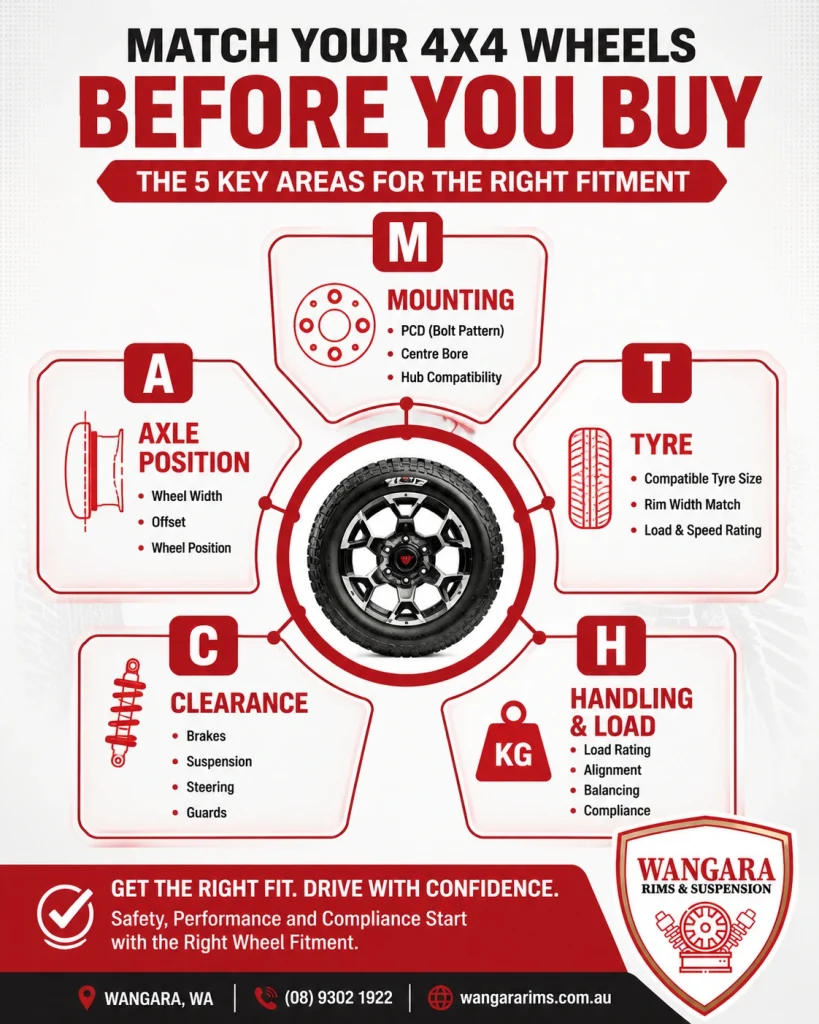
A useful way to remember what to check is the MATCH process:
MATCH Category | 11-Step Checks |
M – Mounting | 1)Find factory specs |
A – Axle position | 4)Choose diameter & width |
T – Tyre | 7)Select a compatible tyre |
C – Clearance | 8)Check brakes, suspension, steering & guards |
H – Handling and load | 9)Confirm load rating |
MATCH = 5 things you need to get right
↓
11 Checks = how you actually get them right
4×4 Wheel Size Guide: 11 Checks to Make Before You Buy
- Find your factory wheel specifications
- Match the PCD
- Check the centre bore
- Choose an appropriate diameter and width
- Compare wheel offset
- Calculate the change in wheel position
- Select a compatible tyre
- Check brake, suspension, steering and guard clearance
- Confirm the wheel’s load rating
- Check the setup against WA requirements
- Have the final setup professionally fitted, balanced and aligned
Each of these is covered in detail below.
Step 1: Find Your 4×4’s Factory Wheel Specifications
Start with the manufacturer’s wheel specifications for your exact model and variant, not a general figure for your vehicle’s range. At minimum, you need the original diameter, width, PCD, offset and centre bore before comparing an aftermarket wheel against it.
These specifications are usually written in a shorthand like this:
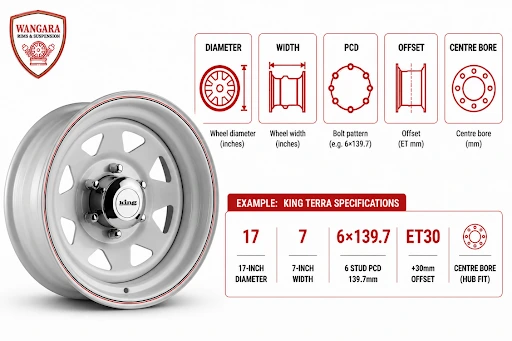
KING Terra 17 × 7 6×139.7 ET30
Marking | Meaning |
17 | 17-inch wheel diameter |
7 | 7-inch nominal wheel width |
6×139.7 | Six-stud PCD, bolt circle measuring 139.7mm |
ET30 | +30mm wheel offset |
Wangara Rims & Suspension stocks the KING Terra in this 17×7 6×139.7 ET30 specification, making it a useful real-world example of how wheel specifications are written. Once you know your own vehicle’s version of these numbers, every step below is a matter of comparing a proposed wheel against it.
Step 2: Does the PCD Match Your 4×4?
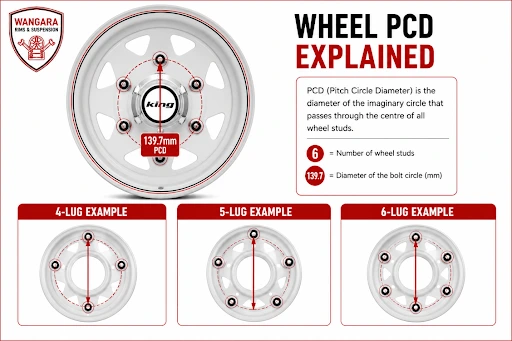
Match the proposed wheel’s PCD to your 4×4’s hub specification exactly. A wheel with the wrong bolt pattern isn’t compatible, even if its diameter and width look right.
What is PCD (Pitch Circle Diameter)?
PCD, or pitch circle diameter, describes your wheel’s bolt pattern: how many wheel studs there are and the diameter of the imaginary circle running through their centres. A 6×139.7 PCD means six-wheel studs arranged around a 139.7mm-diameter circle. This pattern is used on many popular 4×4 applications, but PCD can vary by model, generation and variant, so always confirm the specification for your exact vehicle.
PCD Explained:
You will usually see PCD written as two numbers, such as 6×139.7:
- 6 = the number of wheel studs or mounting holes
- 139.7 = the diameter, in millimetres, of the imaginary circle passing through the centre of those mounting positions
Both measurements matter. For example, a six-stud wheel is not automatically compatible with every six-stud 4×4; the bolt-circle diameter must also match the vehicle’s specification.
How to Measure Wheel PCD?
Count the studs on your hub, then measure across the bolt circle. On a six-stud wheel, measure centre-to-centre between two studs directly opposite each other. On an odd stud count, measure from one stud’s centre to the outer edge of the hole diagonally across, since there’s no stud directly opposite to measure to. If you’re not confident measuring it yourself, the team at Wangara can confirm your PCD in person.
Step 3: Does the Centre Bore Fit the Vehicle Hub?
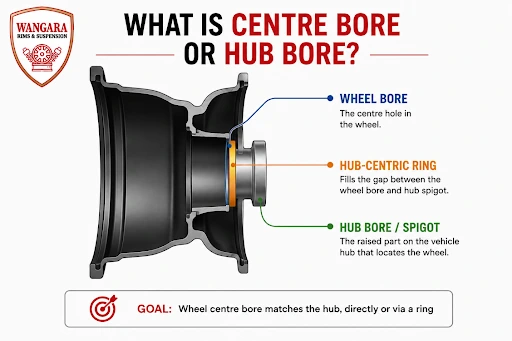
The centre bore is the hole in the middle of the wheel that fits over the vehicle’s hub spigot. For correct fitment, it must either match the hub diameter or be larger and use a correctly sized hub-centric ring where appropriate. If the centre bore is smaller than the hub, the wheel will not fit.
Check that the wheel uses a centre bore and locating method compatible with your 4×4’s hub. A matching PCD alone doesn’t make a wheel suitable. For replacement alloy rims, the wheel should locate on the same-diameter centre spigot as the original, with suitable adaptor rings used where necessary. The wheel nuts or bolts must also suit the wheel’s seating/taper.
Many aftermarket wheels use a larger centre bore so they can suit multiple vehicles, with correctly sized hub-centric rings used for compatible applications. These rings fill the difference between the wheel bore and hub spigot and help centre the wheel correctly during installation.
Step 4: What Wheel Diameter and Width Should You Choose?
Choose diameter based on tyre availability, brake clearance and intended use, and choose width according to the tyre you plan to run and available clearance. Bigger isn’t automatically better for either measurement.
Diameter affects how much tyre sidewall you have to work with. For a similar overall tyre diameter, a larger wheel generally requires a lower-profile tyre, leaving less sidewall to absorb impacts off-road. Width needs to suit the tyre you plan to fit, so check that the tyre is approved for the selected rim width rather than assuming any tyre of a similar size will work.
If You Go Wider, Recalculate Offset
Changing width doesn’t just change the tyre’s footprint. It also changes how far the wheel sits from the hub relative to your factory setup, even if the offset number stays the same. That’s why width and offset need to be assessed together, which is covered next.
Step 5: What 4×4 Wheel Offset Will Fit?
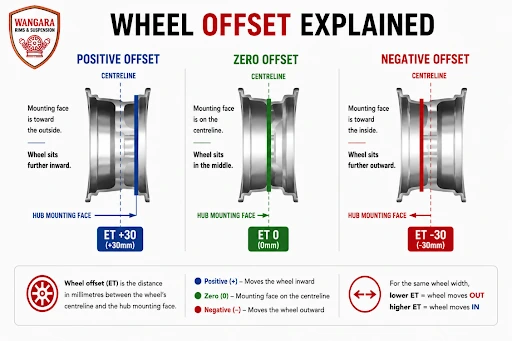
The correct 4×4 wheel offset positions the wheel and tyre with adequate clearance inside and outside the wheel well, for the width you’ve chosen. As a rule, lowering the offset number moves a same-width wheel outward; raising it moves the wheel inward.
What is Wheel offset?
Wheel offset is the distance, measured in millimetres, between the wheel’s centreline and the mounting face that sits against the hub. It is usually shown as ET. For example, ET30 means a +30mm offset.
Offset can be:
- Positive: The mounting face sits toward the outer face of the wheel, positioning the wheel further inward. For the same wheel width, an ET45 wheel sits 10mm further inward than an ET35 wheel.
- Zero: The mounting face sits directly on the wheel’s centreline.
- Negative: The mounting face sits toward the inner side of the wheel, positioning the wheel further outward and often creating a deeper-dish appearance.
As a general rule, for wheels of the same width, lowering the offset moves the wheel outward, while increasing the offset moves it inward.
Why Wheel Width and Offset Must Be Compared Together
Offset only tells you the full story once you know the width it’s paired with. Take a factory wheel specified as 17×7 ET30, compared with a proposed wheel at 17×8 ET15. It’s not enough to say the ET15 wheel “sticks out 15mm more” than the ET30 wheel, because the width has also grown by an inch, and that extra width adds to the wheel’s overall poke as well. The next step shows how to work that out properly.
How to Measure Wheel Offset?
Check the back of the wheel for an ET marking before measuring manually. Most aftermarket wheels have the offset stamped on the inside barrel, for example ET30 for a +30mm offset. If there’s no marking, or you’re checking a wheel you already own, measure it manually:
- Measure the wheel’s total width from outside edge to outside edge, then divide by two to find the centreline
- Measure the backspacing, which is the distance from the back edge of the rim to the wheel’s mounting face
- Subtract the centreline measurement from the backspacing measurement, and convert to millimetres, to get the offset
A wheel labelled 17×7 has a nominal bead-seat width of 7 inches, which isn’t the same as its total outside-to-outside width, so measure the wheel itself rather than relying on the labelled width alone. If you’d rather skip the manual measuring, Wangara can measure and confirm offset in person.
Step 6: How Do You Calculate Where the New Wheel Will Sit?
To estimate how a change affects wheel position, add the effect of any width increase to the effect of the offset change. Using the 17×7 ET30 to 17×8 ET15 example:
- The extra inch of width equals roughly 25.4mm, split evenly across both sides of the wheel, adding around 12.7mm to each edge
- The offset has dropped by 15mm, from ET30 to ET15, which moves the whole wheel 15mm further outward
Combined, that puts the outer edge roughly 27.7mm further out than the factory wheel (12.7mm from the extra width plus 15mm from the offset change), and the inner edge roughly 2.3mm further in. This tells you how the wheel’s position changes relative to your factory setup. It doesn’t confirm the wheel will actually clear your guards, suspension or brakes — tyre dimensions and vehicle-specific geometry still need checking, covered in Step 8.
Step 7: Will Your Tyre Size Work with the New Wheel?
Choose a tyre that suits both the new wheel’s width and your vehicle’s overall gearing and speedometer accuracy, not just one that physically fits on the rim. A tyre that’s too narrow or too wide for the rim width can affect handling and tyre wear, even if the wheel itself fits perfectly.
Also compare the tyre’s overall diameter with the manufacturer’s specified sizes. Changing overall diameter affects effective gearing and the relationship between road speed and wheel rotation, so speedometer accuracy must remain within the applicable requirements. The tyre must also have the appropriate load and speed rating for the vehicle.
Step 8: What Clearance Should You Check Before Fitting 4×4 Wheels?
Don’t check clearance only with an unloaded 4×4 parked on level ground. Check the complete wheel-and-tyre assembly against the brakes, suspension, steering, inner guards and outer bodywork as the steering moves from lock to lock, the suspension travels and the vehicle carries its expected load.
Specifically, check:
- Brake calipers and rotors, particularly if you’ve upgraded brakes
- Suspension components, including control arms and sway bars
- Steering components at full lock
- Inner guards, through full suspension travel
- Outer guards and bodywork, with the wheels turned to full lock
A setup that clears everything with the vehicle sitting still can still rub once the suspension compresses or the steering turns — one of the more common issues we see with 4x4s fitted with wider wheels but no proper clearance check.
Step 9: Is the Wheel Load Rating Suitable for Your 4×4?
Choose a wheel with a load rating suited to your vehicle and how you use it, rather than assuming any wheel rated for a 4×4 will do. This matters more on a 4×4, because the extra weight of a bullbar, canopy, drawers, tools or touring gear all adds to the load the wheel carries.
There’s no single minimum rating that applies across every 4×4, since it depends on your vehicle’s GVM, how it’s set up and what you’re carrying. If your 4×4 is fitted out for touring or work, have your intended setup checked against the wheel’s rated capacity before you buy.
Step 10: Is Your 4×4 Wheel Fitment Legal in WA?
Before ordering wheels that materially change your width, offset, track or overall tyre setup, confirm the combination meets the requirements that apply to your vehicle in WA. Vehicles on WA roads must comply with the applicable Western Australian regulations and Australian Design Rules, and WA references the National Code of Practice (VSB 14) when assessing light-vehicle modifications, including wheel and tyre changes.
Modifications are generally treated as minor, simple or complex, and some need inspection or engineering approval before they’re legal to drive on. Which category a change falls into depends on your specific vehicle, so it isn’t something to assume from a general rule of thumb online. Check your proposed setup against current WA Department of Transport requirements, or ask your fitter to flag anything that needs formal approval, before you commit to a purchase.
Step 11: What Should Happen After You’ve Chosen the Wheels?
Once you’ve settled on a wheel and tyre setup, have it properly fitted, balanced and, where needed, aligned, rather than treating installation as an afterthought. Correct fitting confirms the checks above hold up in practice, balancing prevents vibration at speed, and alignment keeps steering and tyre wear on track.
At Wangara Rims & Suspension, this is where our team can help directly. We supply and fit wheels and rims, offer 4WD suspension and lift kits, and carry out wheel alignment and wheel balancingon-site in Wangara, so the whole process happens under one roof.
Once Fitment Is Sorted, Should You Choose Alloy or Steel Wheels for 4×4?
For alloy vs steel wheels for a 4×4, material doesn’t determine whether a wheel fits. PCD, centre bore, dimensions, offset, clearance and load rating still need to be correct regardless of which material you choose. Once those are sorted, the choice comes down to your vehicle’s use, weight, durability needs, appearance and budget.
As a general guide, steel wheels tend to be tougher in harsh conditions and easier to repair by bending back into shape, while alloy wheels are lighter, more resistant to corrosion, and offer a wider range of finishes. Neither is a wrong choice. For a full breakdown, see our dedicated steel vs alloy rims comparison.
4×4 Wheel Fitment Checklist Before You Buy
Check | Question |
Vehicle specs | Do I know my exact variant’s factory specs? |
PCD | Does the bolt pattern match? |
Centre bore | Is it compatible with the hub? |
Diameter | Is it appropriate for my use? |
Width | Does it suit the tyre and clearance? |
Offset | Where will it sit relative to stock? |
Tyre | Compatible with the wheel and vehicle? |
Inner clearance | Clears suspension and steering? |
Outer clearance | Clears guards and bodywork? |
Brakes | Clears the brake assembly? |
Load rating | Appropriately rated for my setup? |
Compliance | Suitable under WA requirements? |
Installation | Fitted, balanced and aligned? |
FAQs
What does 6×139.7 mean on a 4×4 wheel?
It means the wheel has six studs arranged on a 139.7mm bolt circle.
How do I know what wheel offset will fit my 4×4?
There’s no single number that fits every 4×4. Start from your factory offset, compare it against the width and offset of the wheel you’re considering, then check the resulting inner and outer clearance before you buy.
Does a lower offset make 4×4 wheels stick out further?
For the same wheel width, yes. Lowering the offset number moves the wheel further outward from the hub; raising it moves the wheel further inward.
Can I fit wider wheels if the PCD is the same?
Not automatically. A matching PCD only confirms the wheel will bolt on. Width, offset, centre bore, tyre compatibility, load rating and clearance still need to be checked separately.
Do I need a wheel alignment after fitting new wheels?
In most cases, yes, particularly if the new wheels differ in offset, width or diameter from your factory setup. Your fitter can confirm whether alignment is needed based on your change and current alignment condition.
Let Wangara Rims & Suspension Get Your 4×4 Fitment Right, the First Time
Getting offset, PCD or clearance wrong isn’t just an inconvenience; it can mean rubbing tyres, uneven wear, a failed check, or wheels that have to go straight back. Skip the guesswork. Bring your 4×4 into our Wangara showroom and our team will confirm your exact fitment, match the right wheels to your vehicle and how you use it, then handle the full install with precision alignment and balancing, backed by our workmanship guarantee.